
One of the most successful public health campaigns ever just crossed a milestone: for the first time ever, less than 10% (9.9% to be exact) of American adults are smokers! Given that it was as high as 42.4% in the 60's, this massive reduction of one of the most harmful habits is a testament to decades of policy changes, public health messaging, legal settlements, and medical advances.
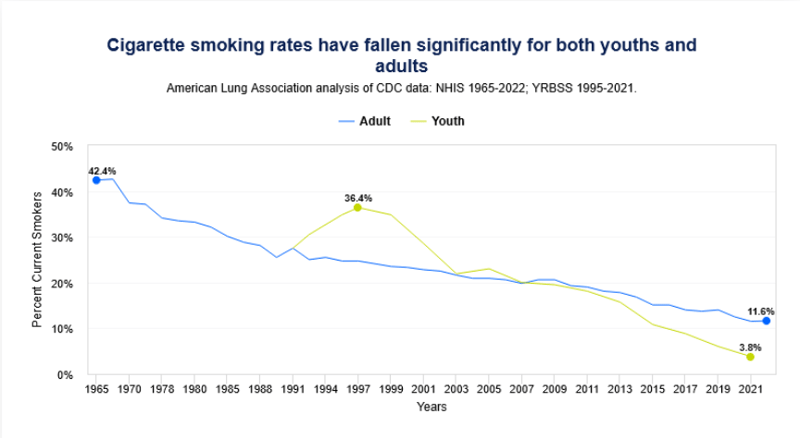
But as impressive as this statistic is, it hides a more complicated story. The National Health Interview Survey found that for adults that didn't graduate high school, it might as well still be the 60's, with 42.8% of them reported as tobacco users. High rates of tobacco use were also found among other disadvantaged populations, such as those with a low-income (24.4%), who live in rural areas (27%), and with disabilities (21.5%).
When we look across the DRVS footprint of over 1000 health centers, hospitals, and practices a similar story emerges. For the over 12 million adolescents & adults screened for tobacco use by Providers on DRVS in 2025, 17% of them reported tobacco use; several points higher than the national average. This makes sense in the context of the safety-net population that Azara works with (33% of those screened are at or below 200% of the poverty level) and the previously mentioned increase in tobacco usage rates among the low-income Americans. That safety-net focus also comes with a rich set of social drivers of health data collected by care-teams using PRAPARE, and it allows us to drill into the numbers even deeper than what the NIHS had available.
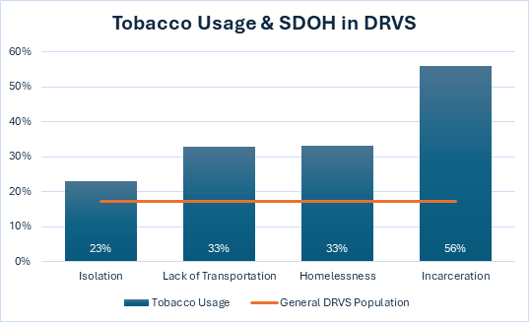
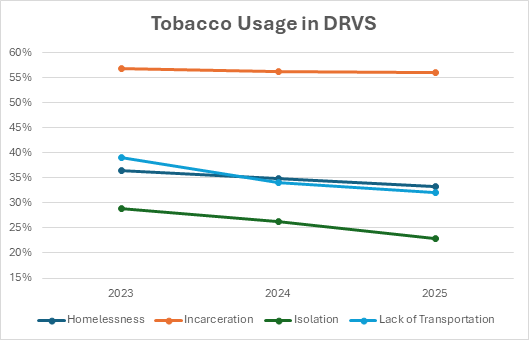
For example, we can see that 33% of patients reporting a lack of transportation use tobacco, which is double the DRVS average and triple the national average. Even more disparity is seen in the level of smoking among individuals with a recent history of incarceration, where-in 56% of them are reporting tobacco use. Given that incarceration is correlated with poverty, education deficiencies, homelessness, & isolation this high rate of smoking reflects the compounding affects of multiple social drivers of health on the same patient population. Such a challenge makes it worthy of dedicated public health attention, especially given that while the other populations are seeing a decline in tobacco usage rates, the rate for patients with a history of incarceration has remained stubbornly high for the past 3 years.
All of this doesn’t diminish the achievement of having hit this sub-10% milestone. As an indicator of progress, the average matters; but averages do not tell you who is still carrying the burden. Such a wide range of experiences for patients with different social drivers of health speaks to the need for tailored strategies for each patient sub-population. If we want to continue to drive down the rates of tobacco usage and the associated respiratory diseases, cardiovascular disease, and cancers that come with it, broadly focused campaigned won’t cut it. It’ll require grassroots public health teams having access to rich data sets that they can turn into micro-targeted programs and policies. It’s through population health tools like Azara DRVS that we can turn the mirage of the average into a reality for all patients.
Related Articles

Supporting Better Cholesterol Management with New AMA MAP™ Measures in DRVS
Explore Insights
Why Community Trust Is the Foundation of Population Health
Explore Insights