If there’s one thing I’ve learned working with rural health centers, hospitals, and health plans, it’s this: data isn’t an accessory in healthcare—it’s infrastructure. Like roads, electricity, or broadband, data determines whether rural patients get timely care, whether providers are paid fairly for the complexity they manage, and whether states can point to measurable impact when the federal government asks, “What did you do with the dollars we sent you?”
With the Rural Health Transformation Program (RHTP) setting the stage for the largest coordinated investment in rural health in decades, the stakes couldn’t be higher. Health Centers and Hospitals already serve as the epicenter of care in many rural communities. But without a shared, reliable data lattice—one that connects Federally Qualified Health Centers (FQHC), Community Behavioral Health Clinics (CCBHCs), Rural Health Clinics (RHCs), Critical Access Hospitals (CAH), community-based organizations(CBOs), public health departments, and health plans across clinical, claims, SDOH, and care management workflows—we’re effectively driving without a speedometer, odometer, or gas gauge.
Why Rural Healthcare Needs a Shared Data Lattice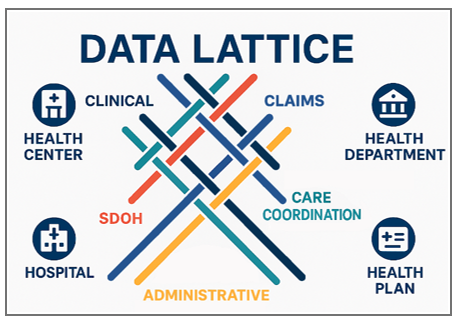
Rural healthcare has always been defined by scarcity—fewer providers, fewer care settings, fewer staff hours to go around. But scarcity doesn’t just live inside the clinic; it shows up in the data too. Fragmented networks across multiple EHRs, unpredictable claims feeds, manual documentation workflows, incomplete patient registries, and lagging referral information create blind spots everywhere.
Local, county, and state public health departments also sit on essential surveillance, immunization, communicable disease, and population‑level datasets that rarely make their way into point‑of‑care workflows. Those blind spots widen care gaps, erode reimbursement, and can make county and state‑level reporting feel like guesswork.
That’s why the concept of a unified Health Center–Hospital–Health Plan data lattice is so powerful. It establishes a normalized, shared layer of truth across organizations that—let’s be honest—haven’t always been able to operate like a coherent network. When primary care staff can coordinate care with the behavioral health provider down the road, when a hospital can reconcile their member attribution and risk adjustment from the health plan, when a health plan can accurately assess quality gaps and SDOH load across its rural members; patients receive better, more coordinated care.
This shared lattice isn’t a monolithic new system—it’s a smart integration framework that leverages all the digitization and interoperability investments the US has made in its health system in the past 15 years. But it’s also about finding partners that share patients, have a shared mission of improving rural health, and a shared commitment to innovation.
This shared lattice isn’t a monolithic new system—it’s a smart integration framework that leverages all the digitization and interoperability investments the US has made in its health system in the past 15 years.
In rural communities, where about 20% of the US population lives, data infrastructure matters more than ever. Without it, we’re placing the burden on rural clinicians to “just work harder” instead of designing systems that work smarter around them. The explosion of generative AI makes this all the more possible, as rote data transformation and report writing tasks can be accelerated with thoughtfully implemented tools.
Stitching the rural health landscape together will require:
- Clinical data from multi-EHR environments (yes, even the messy ones).
- Claims and utilization data from Medicaid and Medicare Advantage plans to tighten risk accuracy and total medical expense visibility.
- Referral, Admission, & Discharge data to keep transitions of care from slipping through the cracks.
- SDOH and care management signals elevated directly into clinical workflows.
- Regulatory and value-based care reporting automated enough that operational leaders can use them for daily quality improvement initiatives.
- Public health insights for disease surveillance shared with providers and plans so they understand the community-level risks they’re managing.
A shared data lattice is how we stop accepting that fragmentation is inevitable and start treating data infrastructure the same way we treat physical infrastructure: as essential to rural communities and a foundation for future growth.
How the Data Lattice Proves ROI to States
States aren’t just looking for effort—they’re looking for outcomes they can defend. When RHTP dollars start flowing, every state will need a clear story about what it bought, what was delivered, and how that moved the needle on rural health indicators. That’s where the data lattice becomes more than an IT investment; it becomes the backbone of the state’s ROI narrative.
Without a shared AI-powered data infrastructure, ROI calculations are unreliable, delayed, or just downright impossible. But with it, the math becomes straightforward. Avoided ED visits become quantifiable reductions in avoidable cost. Closed care gaps become improved quality measures and earlier interventions. Accurate risk capture becomes appropriate reimbursement for the true complexity rural providers manage. Reduced network leakage becomes measurable savings when care stays in‑community. Improved maternal, behavioral health, or chronic disease outcomes become year‑over‑year trendlines states can proudly point to.
It’s the same principle that Azara has seen with point of care quality and risk gap closure: when clinicians have the right data at the right time, their actions change—and the financial impact follows. If we scale this across a rural health ecosystem with policy makers having the right data at the right time, then the ROI of the RHTP compounds.
For state departments of health and advocacy organizations, this isn’t just operationally attractive—it’s politically powerful. Participating in a shared data lattice transforms siloed public health reporting into real‑time intelligence that supports both community prevention and clinical care coordination. It enables:
- Rural impact scorecards that roll up health center, hospital, and plan metrics that show legislators where dollars are delivering outcomes.
- Predictable year‑over‑year improvements on health, workforce, and operational indicators, instead of crisis‑driven improvisation.
- The ability to course‑correct early, because reliable information shows up in time for decision making.
For health centers and hospitals, the benefit is immediate: fewer data blind spots, better alignment with state RHTP plans, and the ability to demonstrate value with hard evidence. And if it’s done with the right technology partner, this is all possible without adding a new reporting burden.
Building a rural health data lattice isn’t about technology for technology’s sake—it’s about giving independent rural providers the same visibility, coordination, and analytic strength that larger systems take for granted. Rural patients, and the clinicians who serve them, deserve data infrastructure that works as hard as they do, and Azara is the partner of choice for those organizations.
While rural populations make up 20% of the US, they represent 31% of the clinical visits at provider organizations on Azara. With a proven track record of integrating messy multi‑source data, powering point‑of‑care decision‑making, enabling accurate risk capture, integrating generative AI tools, collaborating with public health departments, and aligning health centers, hospitals, and health plans around shared truth, Azara is uniquely positioned to help organizations turn this data lattice vision into an operational reality.
Rural communities are ready for measurable transformation—and with the right partner, they don’t have to wait years to see it.
Related Articles

From Funding to Transformation: 4 Solutions Helping Rural Healthcare Organizations Achieve RHTP Goals
Explore Insights
Why Community Trust Is the Foundation of Population Health
Explore Insights